

Seven years, one Dean: the stats legend who kept FLASS moving FORWARD

Even though Professor Li Wai-keung steps down from the deanship in May 2026, a role he has held since July 2019, he will continue to be part of our community as Research Chair Professor of Data Science, affiliated to the Department of Mathematics and Information Technology.

Professor Li with his PhD thesis. The late Sir Clive Granger (1934–2009), Nobel Prize winner in Economic Sciences in 2003, served as his PhD external examiner.

Professor Li pictured alongside fellow Croucher Foundation Senior Research Fellow Awardees (2003-2004).
Professor Li Wai-keung assumed the deanship of FLASS in July 2019. After leading the Faculty for almost seven years, he will step down in May 2026. He will continue to be part of our community as Research Chair Professor of Data Science, affiliated to the Department of Mathematics and Information Technology.
Before becoming Dean of FLASS, Professor Li was Chair Professor in Statistics at The University of Hong Kong (HKU), which he joined in 1983. During his tenure at HKU, he held several leadership roles, including Head of the Department of Statistics and Actuarial Science (January 1997 – December 1999; January 2006 – December 2008; September 2011 – August 2017), Director of the Big Data Research Cluster, and Associate Dean (Research) of the Faculty of Social Sciences.
Professor Li is renowned for his work in time series analysis. Over the years, he has published 157 refereed journal articles and one single-authored monograph published by Chapman & Hall. His academic work is widely cited in papers, textbooks, and computer software. Professor Li is a Fellow of the American Statistical Association and the Institute of Mathematical Statistics.
On the occasion of his departure, FLASS FORWARD is honoured to interview him about what motivated him to become an academic, his management philosophy for higher education institutions, and his words of advice to young scholars.

Richard Feynman was awarded the Nobel Prize in Physics in 1965 alongside Julian Schwinger and Sin-Itiro Tomonaga for their independent work in quantum electrodynamics, which had profound impacts on understanding the relationship between matter and light.
A1: I came across a story about Richard Feynman (1918–1988) yesterday that really resonated with me. The American theoretical physicist is legendary not just for his Nobel Prize-winning work in quantum electrodynamics, but for his sheer brilliance. There’s an anecdote in which a student asked him whether he should pursue theoretical physics as a career. Instead of giving a long lecture, Feynman told him to look through an electron microscope and check whether his heart started pounding at the sight of an electron.
I think that “heart-pounding” moment is everything. If you’re considering a life in academia, there has to be a question that pulls at you—something you can’t help but dive into. It is this drive to discovery that urges you to spend months grasping a difficult concept, years unlocking a puzzle, and an entire lifetime understanding the subject inside out. For thousands of years, this curiosity has been the engine behind human progress. It is this curiosity that drove giants like Isaac Newton (1643 – 1727), James Clerk Maxwell (1831–1879), and Albert Einstein (1879 – 1955) to spend their whole lives pushing the boundaries of the known, building the foundations of modern science as we understand it today.

Isaac Newton, James Clerk Maxwell, and Albert Einstein are among the greatest minds in human history. Newton established the classical framework of mechanics; Maxwell unified and extended physics into fields and waves; Einstein reworked the foundations of space, time, and gravitation and influenced quantum mechanics and cosmology.
A2: James Clerk Maxwell is one of the greatest minds in human history, yet his contributions are often underappreciated. The Scottish scientist unified electricity, magnetism, and light into a single theoretical framework, and his mathematical formulations enabled precise predictions of electromagnetic phenomena.
People praise Michael Faraday (1791–1867) for conducting a series of decisive experiments in electricity and magnetism. Faraday made numerous discoveries, such as a changing magnetic field can induce an electric current in a conductor, and that electric currents can produce motion, which is the basis for electric motors. It is true that Faraday made many epoch-making discoveries through experiment. But it was Maxwell who revolutionised physics by explaining how Faraday’s discoveries actually work. It is Maxwell’s four equations that describe how electric and magnetic fields interact. He laid much of the groundwork for electromagnetism, and hence for modern physics.
The most important quality of being an academic is the love of knowledge and the curiosity to explore the unknown.
In many ways, Maxwell’s contribution to modern science is as monumental as Einstein’s. His work reshaped the way scientists conceive of fields, waves, and the unity of physical laws. Maxwell’s life was shaped not only by his intellect but also by his character. A devout Christian, he was known for his piety and his consistently cheerful disposition. From youth he displayed an unquenchable thirst for knowledge, and he derived genuine enjoyment from scientific exploration throughout his career.
I think Maxwell tells us that whether we are mathematicians, physicists, chemists, social scientists, or anything else, the most important quality of being an academic is the love of knowledge and the curiosity to explore the unknown.
A3: Pioneers like Newton, Maxwell, Einstein, and Feynman were among the rare few who could experience the ultimate moments of cosmic elegance and beauty firsthand. While most of us will never encounter such profound intensity in our own work, we are not entirely excluded from that world. By studying their discoveries and understanding their lives, we can draw remarkably close to their moments of wonder. It is much like witnessing a duel between master swordsmen in Wulin (武林), the imagined martial arts world of Kungfu fictions. Although we may never master the intricate techniques of such masters or replicate their “jaw-dropping” feats ourselves, we can witness their majestic craft in combat.

Universities are institutions where knowledge is transmitted across generations in an organised, systematic way through teaching, research supervision, and institutional practices. University teachers bear a great responsibility to take up the baton and safeguard this transmission of knowledge.
A4: While the thrill of discovery drew me to this journey, I also find great joy in nurturing students. As teachers, we are not just imparting hard knowledge—facts, figures, theories, and so forth, we are passing on an academic legacy and sparking a flame of curiosity in our students. Humans are mortal. I think passing on knowledge to the next generation makes our lives as academics far more meaningful. Having spent decades teaching at several universities, I have also drawn a great deal of inspiration for my research from teaching itself.
Over the years, I have been lucky enough to cross paths with some truly brilliant students. To be honest, some of them have even outshone me in their research, and I have loved every moment of our collaborations. While some of my students have remained in the ivory tower after graduation, others have gone on to work in industry, commerce, or other sectors. Seeing them become leaders in their own right, and knowing that we still share a genuine friendship after all these years, is where my pride lies.
A5: As a leader in academia, I believe we have a sacred responsibility to ensure the inheritance of knowledge. I only became an expert in time series analysis because my predecessors selflessly shared their wisdom with me.
This accumulation of knowledge, through discovery and teaching, allows each generation to stand on higher ground.
Too often, scholars prioritise research over teaching disproportionately, forgetting that their own productivity frequently depends on colleagues who shoulder a greater share of the teaching load. Not to mention that individual achievements are almost always built upon the collective work of peers and students. Historically, human knowledge has expanded only because academics taught others their discoveries. This accumulation of knowledge, through discovery and teaching, allows each generation to stand on higher ground. That is why I remind my colleagues and students that teaching is every bit as vital as research.

Professor Li stresses that teaching is as vital as research: new discoveries stand on the collective work laid down by people who came before, and only by passing knowledge on across generations can humans keep wisdom of our predecessors alive. Also pictured at the Faculty Postgraduate Seminar is Professor Philip Yu Leung-ho from the Department of Mathematics and Information Technology.

Professor Li believes that communication is a key part of leadership. He always takes the initiative to speak with his colleagues to understand their concerns. Professor Li is pictured during 2026 Faculty Retreat alongside Dr Manpreet Singh, left, from the Department of Mathematics and Information Technology, and Professor Andrew Edwards, Associate Head of the Department of Health and Physical Education.
When it comes to management, I always return to the philosophy of “無為而無不為”. It literally means “by doing nothing, yet everything is accomplished”. We academics need time to empty ourselves of mundane duties, and mental space to think deeply. I always remind myself that it is better to create an environment in which my colleagues, who are scholars like me, to think freely, than to overburden them with administrative tasks or, worse, to instruct them constantly on what they should do.
I believe genuine communication can help us understand each other, which is important for building trust, aligning goals, and creating an environment where mutual learning and collaboration can flourish. As the Dean of the Faculty, I do my best to find resources for my colleagues, establish a reliable system to empower them, and then step back. When I coach my PhD students, much of my effort goes into cultivating their own internal drive to research. I believe everything will be accomplished when the right foundation is built and when people find genuine joy in their work.
A6: During my deanship, I am glad to have witnessed a number of achievements by the Faculty. We successfully completed the Quality Assurance Council (QAC)’s third audit cycle in 2024 and finalised two triennial Planning Exercise Proposals (PEP) covering the periods 2022-2025 and 2025-2028. We also witnessed the merger of the Department of Social Sciences and the Department of Asian and Policy Studies into the Department of Social Sciences and Policy Studies (SSPS) in July 2023, and the integration of the Department of Cultural and Creative Arts into the Faculty of Humanities in 2024. The establishment of SSPS aligns with the University’s long-term vision to build a strong presence in social sciences and policy research.

It is our top priority to attract talent from around the world to conduct research at FLASS and EdUHK. Alongside providing our research postgraduate students (RPg) with adequate academic guidance, we work hard to support their social and mental wellbeing. Professor Li is pictured at the BBQ party organised for FLASS’ RPg students in December 2024.
Our research capacity has also reached new heights. The Faculty Postgraduate Seminar has been firmly established as a biannual event, fostering a vibrant intellectual community for our research students. Our colleagues have become increasingly active in applying for research grants to support their research and knowledge-transfer endeavours, and their efforts have produced noticeable results — earning numerous prestigious awards and international accolades. We also successfully launched seven new double-degree programmes and a new Bachelor of Arts (Honours) in Personal Finance in the 2025/26 academic year, a timely response to market needs that ensures our curriculum remains competitive in attracting prospective students.
Without their support, the Faculty would not have achieved all that it has, nor thrived as it does today.
I am also glad to see EdUHK’s rising position in both the QS World University Rankings and Asia Rankings—a climb to which this faculty has certainly contributed. I must thank all Associate Deans, Assistant Deans, Heads of Department, faculty members, and administrative staff who have worked closely with me throughout my deanship. Without their support, the Faculty would not have achieved all that it has, nor thrived as it does today.

Professor Li pictured with members of the Faculty’s administrative team at the EdUHK Spring Lunch on 27 February 2026, cheering on Ms Tanya Kwan Hung-hung, Professor Li’s Personal Secretary, as she participated in the EdUHK Sing and Shine during the event.
A7: Soon after joining EdUHK in 2019, I was tasked with leading a project to promote the application of Big Data and Artificial Intelligence (AI) across various departments. At the time, Big Data and AI were already hot topics in academic circles, and research across medicine, science and engineering, the humanities, and the social sciences had begun capitalising on the power of big data analytics and AI.
The project aimed to boost EdUHK’s AI literacy, including strengthening its foundation for future AI-related research. This included making both pre-service and in-service teachers more AI-ready, so that they would not be left behind by the AI revolution. It also involved pedagogical innovation: we worked alongside our academic staff to design teaching methods that incorporated AI elements, and we shared workable practices with local school teachers to promote the use of Big Data and AI in education.
I recall that many colleagues from the Department of Mathematics and Information Technology (MIT) took on an ambassador role to promote AI literacy across the University. Relatedly, I encouraged MIT to introduce a new master’s programme in AI and educational technology. Under the leadership of the then Acting Head of MIT Dr Gary Cheng Kwok-shing, the programme was successfully launched in 2021 and continues to be one of the flagship programmes of the department.
Looking back, both the project and the new programme were visionary. With hindsight, the project was a precursor to the various AI literacy-enhancing initiatives EdUHK launched in the years that followed.

Nobel Prize laureate Sir Clive Granger visited HKU Statistics and Actuarial Science Department in 2006, when Professor Li was the head of the department. Also pictured is Lady Granger.

In 2014, Professor Li met his PhD supervisor Professor A. Ian McLeod at the latter’s festschrift celebration at the University of Western Ontario in Canada. Professor McLeod’s research in time series analysis has garnered international acclaim for both Canada and the University of Western Ontario.
A8: I have met many great minds throughout my academic life. I came to know Sir Clive Granger in the early 1980s, when he served as my PhD external examiner. We maintained a warm relationship thereafter; he went on to share the 2003 Nobel Memorial Prize in Economic Sciences for his transformative work on time series volatility and non-stationarity. From my graduation in 1981 until his passing in 2009, he offered me much valuable advice and inspiration for my research. In 1999 and 2006, I invited him to Hong Kong to give talks and share his research experiences and findings.

An autographed book from Professor Paul Embrechts, presented to Professor Li when Professor Embrechts was invited to visit Hong Kong in 2016 to share his research findings.
Beyond Sir Granger, I have had the privilege of knowing many other leading figures in modern statistics. These include Professor George Tiao Ching-Hwuan (刁錦寰) of the University of Chicago, and the Hong Kong-born Professor Howell Tong (湯家豪), whose work on threshold time series models revolutionised fields as diverse as ecology, economics, and epidemiology. I also feel honoured to know world-renowned statisticians such as Professor Chan Kung-Sik (陳公適), a leader in chaos theory and statistical ecology; Professor Ruey S. Tsay (蔡瑞胸), a master at extracting clarity from “messy” data; and the distinguished Taiwanese econometrician Professor Kuan Chung-ming (管中閔).
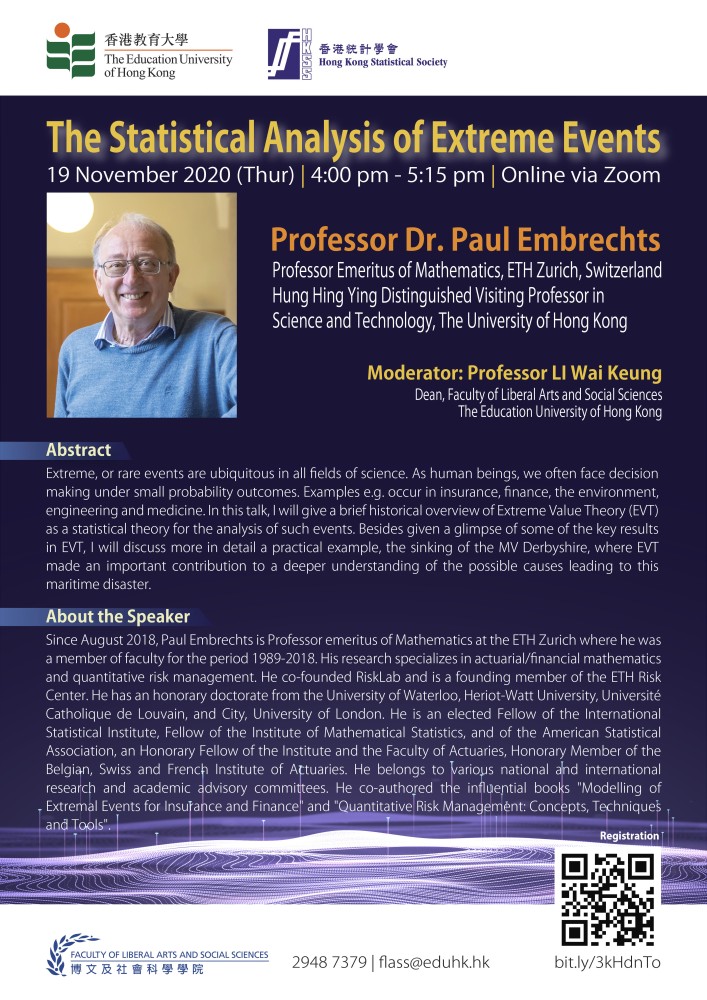
I invited Professor Paul Embrechts to visit HKU in 2016 and EdUHK in 2020 to share his research findings. The Belgium-born scholar is famous for his pioneering work in quantitative risk management and in the study of extremely rare events, commonly known as “Black Swan” events. I must also mention my PhD supervisor, Professor A. Ian McLeod, and the late Professor Michael John McAleer, a prolific giant in the world of econometrics. I feel very proud to have had the opportunity to know these great names in statistical science.
Ego is a double-edged sword.
A9: The ocean of knowledge is truly vast. Facing it, the only sensible attitude is humility. Academic research inevitably fosters pride and can easily enlarge one’s ego — and I believe that ego is a double-edged sword. On one hand, it serves as a powerful drive, pushing a scholar to pursue excellence; on the other, it can make one over-assertive and defensive, eventually reaching a point where one can no longer listen to valuable advice from outside.
True brilliance is rarely a solitary achievement. Isaac Newton once said that he could see further only because he stood on the shoulders of giants. Newton reminds us that every breakthrough we celebrate today is built upon a foundation laid by those who came before, not only our predecessors, but also our peers and even our students in the present day. By remaining humble, a scholar keeps their mind open to correction and collaboration, acknowledges the contributions of others, and stays receptive to new ideas. These are all critical factors for success.

Professor Li says humility keeps a scholar’s mind open, for it welcomes correction, invites collaboration, and stays receptive to fresh ideas. “That openness is not a weakness but the engine of lasting achievement,” he says.
Read Dean’s Message to understand Professor Li’s parting words, and “Professor Li Wai-keung: Grateful for the privilege to play a part in the development of time series analysis” to understand more about his journey of becoming an academician and the words of wisdom that have guided him through his decades-long pursuit of scholarship.
